
Some classic dentures that you get to replace your missing teeth become a problem that deeply affects your daily life and self-confidence. However, you don't have to worry anymore because with the development of technology, great strides have been made in the field of dentures, and solutions have been found to save you from the negative effects of classic dentures.

Whether you are looking for a solution to your tooth loss or you are looking for a permanent solution to replace your old dentures, it is definitely time to get acquainted with overdentures. In this article we will explain in detail what overdentures are, how they are used, their advantages, and when they are needed.
What is Overdenture?
They are removable dentures designed to be placed over the remaining natural tooth or a structure such as an implant that reduces the load on the jawbone and provides better retention support to complete the missing teeth of those who have lost more than one tooth for various reasons. They are also known as implant-supported dentures or snap-on dentures.
Who is a good candidate for Overdentures?
Overdentures are an ideal choice for people who suffer from one or more of the following conditions:
- Those who want to be treated by preserving the remaining intact tooth roots
- Those who have complete edentulism (total loss of teeth) in the upper or lower jaw.
- Those who have difficulty using conventional dentures complain that the denture moves.
- Those who are uncomfortable with the palate coating of removable dentures and have difficulty eating or speaking.
- Anyone who has to constantly use adhesives for dentures,
- Those who want a less expensive option than a full bridge (fixed hybrid prosthesis).
- Those who want a cost advantage as overdentures can support the whole jaw with 2-4 implants.
- Those who want an aesthetic and natural appearance
What are the types of Overdentures?
The overdenture needs a strong support, which we call an abutment. Overdenture types are named according to the type of abutment. The abutment for the overdenture is either the remaining intact teeth or dental implants. If the overdenture is placed on an intact tooth, it is a tooth-supported overdenture. If the overdenture is placed on a dental implant, this is an implant-supported overdenture.
Tooth-supported Overdenture:
A tooth-supported overdenture uses the natural teeth that are still in your mouth. Even the presence of a few remaining teeth reduces alveolar bone resorption. The remaining teeth or tooth roots therefore provide a solid support for the overdenture, and the overdenture is placed on top of it.
Implant-supported Overdenture:
An implant-supported overdenture is a type of overdenture that uses implants in the jawbone as a support. Implant-supported dentures are suitable for many people who have lost most or all of their teeth but have enough bone in their jaw to support the implants. The number of implants can be 2, 4, or 6.
Implant-supported overdentures are an effective treatment option that improves the quality of life of edentulous patients. An implant-borne overdenture requires a surgical procedure to place the implant in the bone.
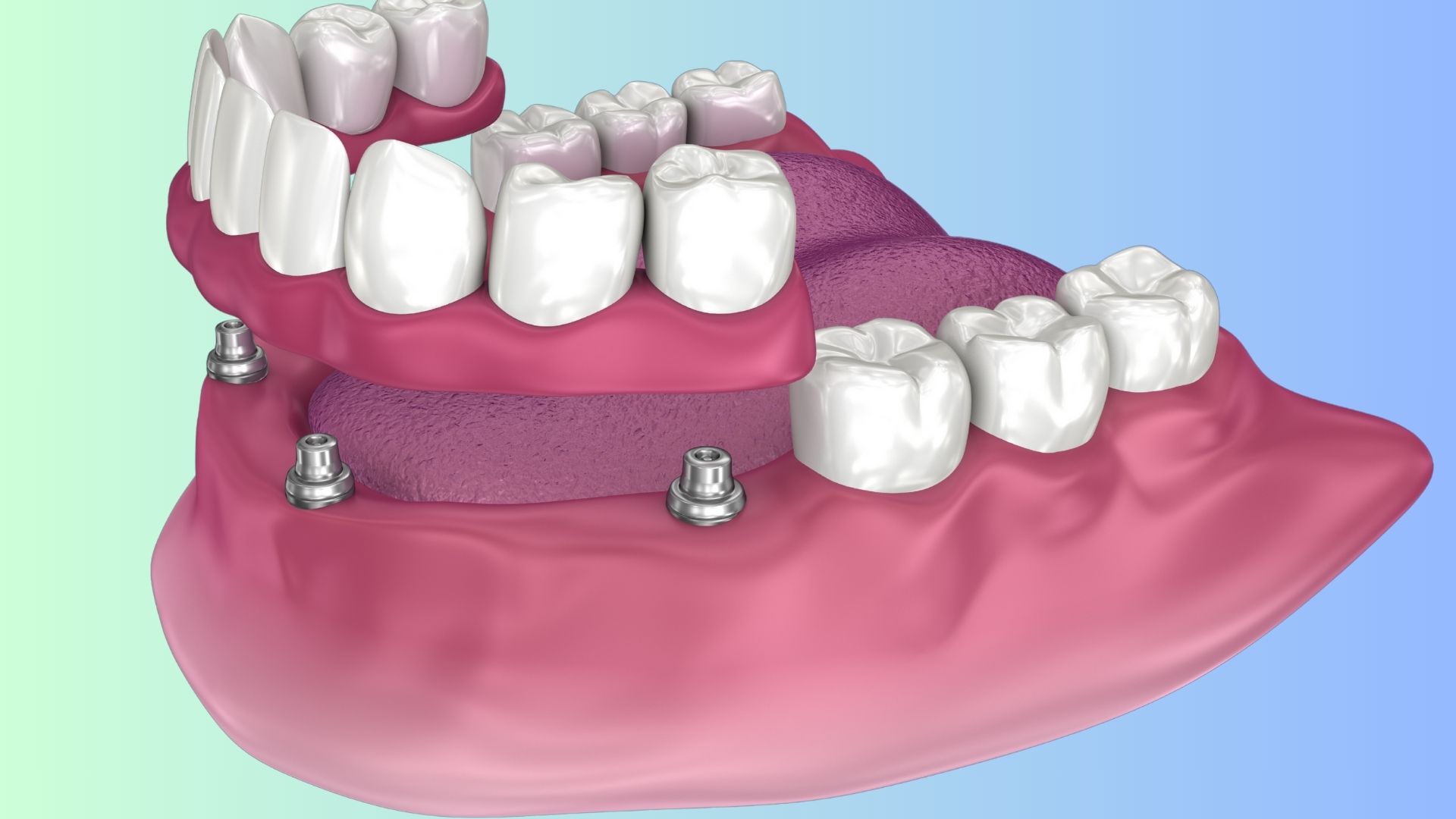
Implant-supported Overdenture types:
Fixed implant-supported Overdenture:
The fixed implant-supported overdenture is secured with screws and cannot be removed. Your dentist must dismantle the denture to remove it. It is usually the most expensive option because it requires four dental implants and screws to hold them in place.
Implant-borne Overdenture with bar retainer:
The bar-retained implant-supported overdenture has a bar attached to the implants to which the denture clips. The bar allows you to remove and insert the overdenture as needed while providing more security than a traditional denture. Most people only remove the denture to clean it or to sleep.
Implant-supported ball-retained Overdentures:
A ball-retained overdenture uses ball-shaped attachments to secure implants to the denture. It provides greater stability and functionality than a conventional denture. Ball retainers make it easier to clean and replace parts when needed.
Which attachment systems used in Overdenture procedures?
An intermediate element is needed for the placement of the overdenture. This intermediate element will connect the tooth roots or implants used to support the overdenture to the overdenture. We call this the retainer system. The retainer system consists of two main parts; one is the male part on the overdenture, and the other is the female part on the support element (tooth roots or implants). The overdenture is fixed by the interlocking of these two main parts. Retainer systems used for overdentures are as follows:
Stud attachments:
The stud attachment system consists of two main parts. One is a round, spherical attachment that is placed on the implant or supporting tooth, and the other is a slot in the inside of the overdenture where the attachment sits. The ball attachment is placed on the implant, and a slot is prepared on the inside of the overdenture. The overdenture with the socket is placed over the ball attachment. It is immobilized and can be easily removed if necessary. Locators, O-ring attachments, and extracoronal flexible (ERA) attachments are widely used as ball attachments.
Bar attachments:
In the bar attachment system, the overdenture is fixed by means of a metal bar placed over the implants. It is a preferred method, especially in cases of complete edentulism.
In the bar attachment system, 2, 4, or 6 implants placed in the jawbone form the basic support on which the bar is fixed. The bar provides the surface for the overdenture to attach to. On the inside of the overdenture are clips or attachments that fit over the bar. These attachments ensure that the overdenture is held firmly and held in place. Bars provide a significant splinting advantage when implants with limited dimensions or unfavorable angles are placed.
Magnetic attachments:
Magnets have not been widely used for dental purposes before. A new system has been developed using magnetic principles to fit the overdenture to the support element. A magnet is used for this. A magnet is placed on the implant or support tooth, and a separate magnet is placed on the overdenture. By mutual attraction of the two magnets, the overdenture is attached to the supporting tooth or simplicity, low cost, automatic reinsertion after removal of the overdenture, and self-adjustment are some of its advantages.
Telescopic attachments:
The telescopic attachment system allows the overdenture to fit by interlocking like a telescope. The telescopic attachment is also known as a "double crown." The inner crown (primary crown) is the metal structure that is fixed on the tooth or implant. The outer crown (secondary crown) is the part of the overdenture that fits into the root and locks into the inner crown. It is very advantageous in tooth-supported overdentures (when there are few intact teeth) and implant-supported overdentures (especially in the mandible).
What is the procedure for applying for an Overdenture?
How is a tooth-supported overdenture made?
Preparation:
When you visit the dentist, the dentist will first take your expectations. He or she will then perform an intraoral examination and use various radiologic imaging methods to determine how the overdenture will be applied. The dentist decides which teeth will be used as support teeth. Support teeth are usually selected from teeth with strong roots. Mostly canines or molars are preferred. If the support teeth need root canal treatment, root canal treatment is completed first. After the support teeth are selected, the following method is applied.
Tooth modification and reduction of support teeth:
Preparation of the teeth where the overdenture will be placed is started. The support teeth are reduced in height and contoured to a convex or dome-shaped surface. This creates space for the dental crown. The tooth is endodontically treated and filled with an amalgam or composite restoration.
Coping preparation:
Coping is the inner metal or zirconium frame that forms the substructure of the overdenture. It covers the root portion of the tooth, i.e., the exposed tooth surface, to enhance the attachment of the overdenture.
Placing attachments:
Attachments, which are precision fasteners placed on the support teeth, ensure that the overdenture is firmly attached to the teeth, prevent the overdenture from slipping, and help lock the overdenture in place. The teeth for attachments are prepared after the required adjustment time. A special diamond rotary tool is used for this preparation.
Overdenture placement:
After the support teeth and attachments have been prepared, the overdenture can now be placed. The prosthesis comes complete according to the impression your dentist has taken from you. Your dentist will place the overdenture prosthesis and ensure that it fits snugly against the support teeth and attachments. Adjustments are then made if necessary.
How to perform an implant supported Overdenture?
The procedure of an implant-supported overdenture prosthesis requires the following process.
Implant placement:
It starts with the process of placing the number of implants determined by your dentist into your jawbone under local anesthesia. In this process, the normal implant placement procedure is applied.
Recovery process:
The procedure initiated for the implant application continues, and the healing process begins for your implant to integrate with the jawbone. This process can take between 3 and 6 months, depending on the patient's condition.
Taking impressions:
Your dentist will take impressions of your implants and mouth and send the impressions to the laboratory to create the overdenture frame and artificial teeth.
Placement of the Overdenture:
After the overdenture is made, your dentist will try it on and make any necessary changes.
What are the pros and cons of overdentures?
Tooth-supported Overdentures:
Pros of tooth-supported dentures:
- Tooth-supported dentures are a quicker and less expensive method of treatment than other methods, but there is an increase in cost and time if additional treatments are required.
- When teeth are retained, the integrity of the alveolar bone is maintained as it supports the supporting teeth, resulting in a reduction in the rate of bone resorption.
- It provides better overdenture support and stability by maintaining the residual ridge contours near the extracted teeth.
- Tactile discrimination is the ability to discriminate information received through the sense of touch. By protecting the teeth, the periodontal membrane is protected, which in turn protects the proprioceptive impulses. As a result, the chewing function is better perceived.
- Patients experience psychological relief due to the restoration of chewing function and a more aesthetic appearance due to the completion of missing teeth.
- In the event of complications with the existing overdenture abutments, the teeth can be extracted and the overdenture converted to a conventional full denture.
Cons of a tooth-supported Overdenture:
- Especially in cases where the interocclusal space is limited, there may be difficulties in aligning the teeth if the space required for the abutment attachment systems is small.
- If the abutment teeth have large bone depressions in this area, especially in the front of the lower jaw, the prosthesis flange may not be able to open fully. This can affect both retention and appearance.
- Additional treatment requirements, coping design, and special attachments may result in additional costs.
- A thin acrylic denture base carries a risk of fracture over time.
- Patients may require scheduled recall appointments to reinforce oral hygiene practices and apply topical fluoride to prevent caries and periodontal disease.
Implant-supported Overdentures:
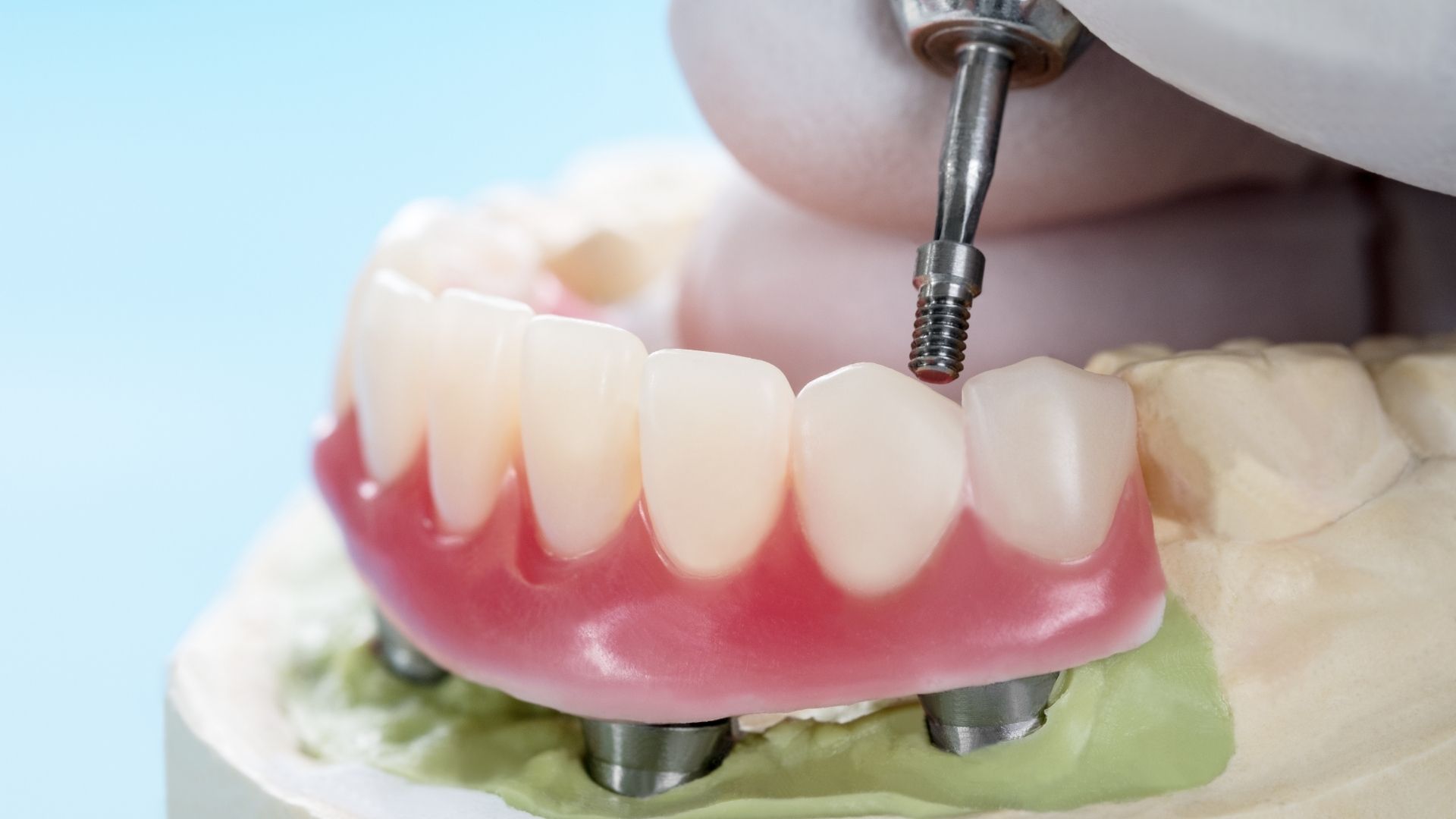
Pros of implant-supported Overdentures:
- It can be made with 2-4 implants, which reduces the cost (compared to traditional fixed prostheses).
- Easy to clean, hygiene can be ensured by removing them.
- It is much more stable than removable dentures; it does not slip or fall.
- Provides chewing force close to natural teeth; you can eat hard foods comfortably.
- No palate coating is required, making taste and speech more natural.
- The prosthesis does not move, providing psychological comfort.
- With good care, implants can be used for a lifetime, and the prosthetic part can be renewed.
- Gums and teeth look natural, and facial fullness is preserved.
Cons of implant-supported Overdenture:
- The cost of treatment depends on the number of implants and materials used.
- Surgery is required to place the implants in the jawbone.
- Some patients (such as those with osteoporosis) may require additional bone grafting.
- It may be necessary to wait 3-6 months for the implants to fuse with the bone (osseointegration).
- If prosthesis cleaning and periodic checks are neglected, the risk of infection increases.
- Wear of the prosthesis or loosening of the connection parts over time.
- Patients with insufficient bone density may require additional treatments.
- Factors such as uncontrolled diabetes can reduce implant success.
How do I care for my Overdenture?
- Remove and rinse the prosthesis with water after each meal (remove any food residue).
- Brush 1-2 times a day with a special soft brush (hard brushes can scratch).
- Disinfect 2-3 times a week using a denture cleaning tablet.
- Clean your gums and tongue with a soft brush.
- If you have an implant, gently brush around the abutment with a special implant brush.
- Reduce the risk of infection by using antibacterial mouthwash.
- Remove the prosthesis at night and soak it in clean water (to prevent drying out).
- Store in a humid environment (prevents prosthesis deformation).
- Avoid biting hard and sticky foods (gum, nuts).
- Do not clean the prosthesis with hot drinks (this can deform it).
- Visit the dentist twice a year (check denture fit and implant health).
- Brush your remaining teeth in a tooth-supported overdenture with fluoride paste.
- Do not press too hard when cleaning metal surfaces in magnetic systems.
Prices of Overdentures
We have prepared the average prices of overdentures according to four countries for you to compare.
Tooth-supported Overdentures prices (Euro):
- Turkey: 1.000 - 2.500 Euros
- UK: 2.500 - 4.500 Euros
- Germany: 2.000 - 4.000 Euros
- USA: 2.500 - 5.000 Euros
Implant-supported Overdenture prices (Euro):
- Turkey: 3.500 - 6.000 Euros
- UK: 6.000 - 9.000 Euros
- Germany: 5.000 - 8.000 Euros
- USA: 6.000 - 10.000 Euros
Frequently Asked Questions
Why are the prices of dentures affordable in Turkey?
The reason for the affordable prices is entirely due to the exchange rate, and patients coming from outside Turkey take advantage of the exchange rate and have their treatment at a more affordable price than in their home countries.
Is it safe to have a dental implant in Turkey?
Yes, the clinics in Turkey are equipped with the latest technology, and both the dentists and other staff are experts and experienced in their fields. Patients from outside Turkey can safely undergo treatment in many areas, including dentures.
Is it possible to combine treatment and holiday in Turkey?
Yes, Turkey has become a center of attraction for health tourism, especially in recent years. Many patients who want to take advantage of the exchange rate come to Turkey from different parts of the world to have their treatment and have a holiday. Package tours, where treatment and holiday are combined, are particularly advantageous.
What materials are Overdentures made from?
Overdentures can be made from acrylic, composite resins, or metal alloys.
How are Overdentures different from traditional dentures?
Overdentures are fixed with implants or natural teeth and provide better support and retention compared to traditional dentures that rely directly on the gums. Because overdentures are held up by natural tooth roots or dental implants, they are more stable and cause less discomfort and movement. Traditional dentures rely solely on vacuums or adhesives to keep them in place.
How long does an Overdenture last?
With proper care and maintenance, dental implants can last a lifetime. For best results, you should replace your overdenture (the denture that fits over your implants) every 15 to 20 years.
Will I feel pain during the Overdenture procedure?
Overdentures are usually performed under local anesthesia, allowing the patient to experience minimal discomfort during the placement of dental implants. Prescription painkillers and appropriate post-operative care can manage mild discomfort and swelling that some patients may experience in the days following surgery.
How long does an Overdenture procedure take?
The duration of the overdenture procedure depends on the type of overdenture, the number of implants or support teeth placed. Both procedures will require more than one appointment. On average, it can take between 3 and 6 months.