
Dental Crown and Dental Veneer in Turkey
Tooth crowns and veneers are both restorative dental treatments, but they serve different purposes. A crown covers the entire tooth to restore strength, shape, and function, making it ideal for severely damaged or weakened teeth. A veneer, on the other hand, is a thin shell bonded to the front surface of the tooth to improve appearance, commonly used for cosmetic enhancements such as discolouration, minor chips, or gaps.
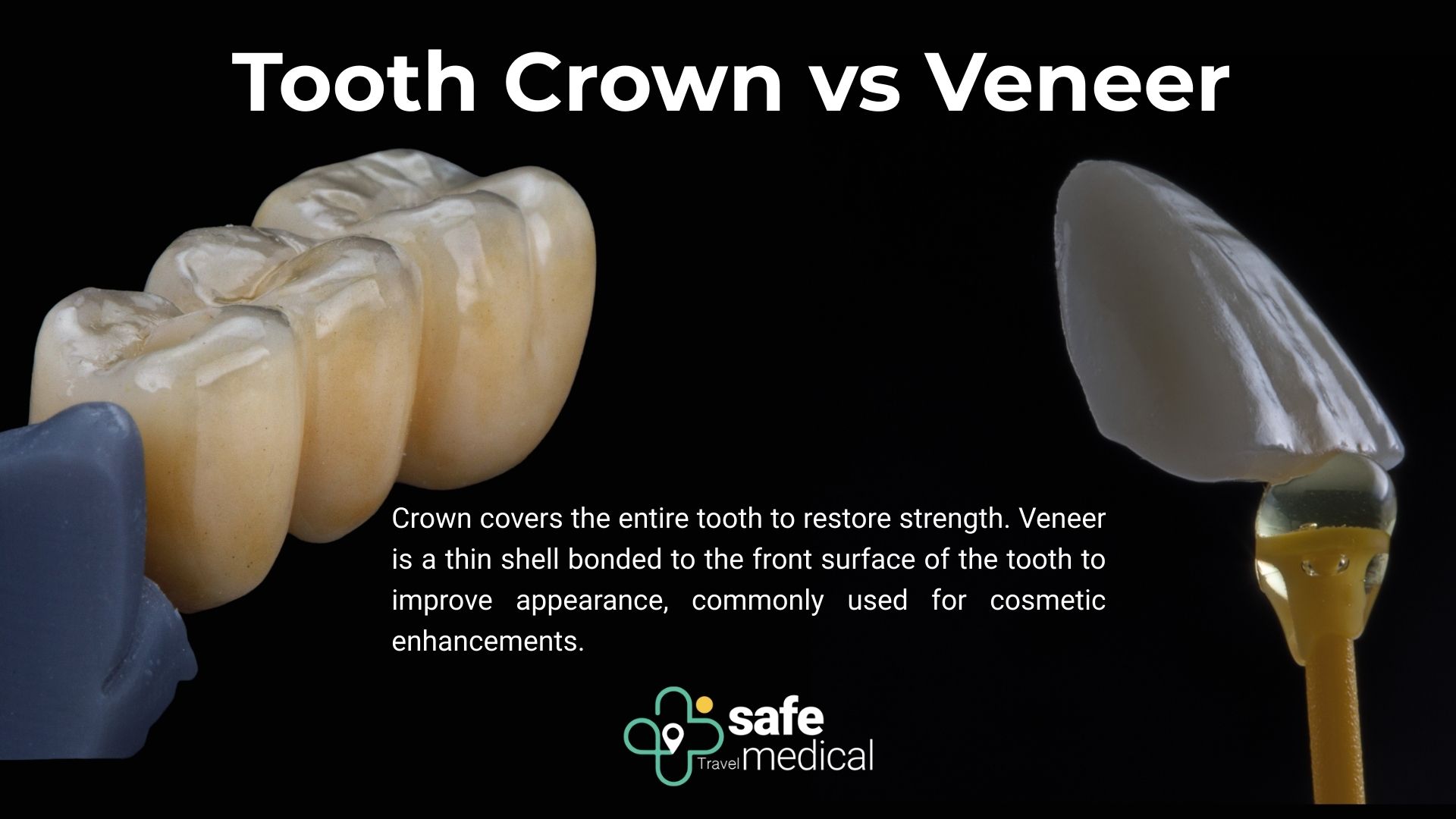
What are dental crowns?
A dental crown is an artificial ‘cap’ placed over a damaged or weakened tooth. This restoration completely covers the entire portion of the natural tooth above the gum line, replacing the tooth's natural enamel.
What are dental veneers?
Dental veneers are very thin shells, specially prepared to cover only the front surface of the teeth in the colour of the teeth. Unlike crowns, which cover the entire tooth, this application is a more protective method used to cover aesthetic imperfections only on the visible part of the tooth.
What’s the difference between a veneer and a crown?
The fundamental difference between a dental crown and a veneer (laminate) lies in how much of the tooth is covered and the purpose of the procedure. In other words, while a crown completely encases the tooth, a veneer only covers the front surface.
The differences between these two procedures are as follows:
Coverage area (How much of the tooth is covered?)
Crown: Completely covers the entire portion of the tooth above the gum line (including the front, back, and sides) like a ‘cap’ or ‘hat’. It protects all chewing surfaces and sides of the tooth.
Veneer: Very thin porcelain or composite layers that cover only the front surface of the tooth that is visible from the outside. It is often compared to attaching a ‘false nail’ to a real nail.
Preparation and tooth reduction (How much reduction is performed?)
Crown: A significant amount of tissue must be removed from all sides and the top of the tooth (shaving). This is necessary for the crown to fit perfectly over the tooth and achieve a natural volume.
Veneer: This is a much more conservative procedure. Only a very small layer of enamel, generally between 0.3 and 0.5 mm, is removed from the front surface of the tooth. In some cases, the back of the tooth is not touched at all.
Purpose of use (Why is it preferred?)
Crown: Its primary purpose is reinforcement and protection. It is used to protect teeth that have undergone root canal treatment, have large fillings, or are broken, cracked, or weakened against chewing forces.
Veneer: Its primary purpose is aesthetic improvement. It is ideal for hiding permanent stains on teeth, repairing small cracks, closing gaps between teeth, or correcting slight misalignments.
What are the types of dental crowns?
Dental crowns are categorised into various types based on both the extent to which they cover the tooth and the materials used in their production. Dentists determine the most suitable option based on the tooth's position in the mouth, the patient's chewing force, and aesthetic expectations.
Dental crown types are broadly categorised, as follows:
Crowns by coverage area
Crowns can be designed to cover the entire tooth or only a specific portion.
Full crowns:
These replace the natural tooth enamel, completely covering the entire chewing surface and sides of the tooth.
Partial veneer crowns (P.V.C.):
These are restorations that cover only part of the tooth. This method is preferred to preserve the sound portions of the tooth. Common types include
3/4 Crowns: This type covers all surfaces except the front (buccal) surface of the tooth.
7/8 Crowns: A type of partial covering typically used on back teeth.
Pinledge restorations: A type of preparation that uses small pins to provide additional retention, particularly on front teeth.
Crowns by material
The most important factor determining the durability and aesthetic appearance of a crown is the material used.
Metal crowns (gold and other alloys):
With a very long history of use, these crowns offer the highest performance in terms of durability and fit. They are particularly preferred for back teeth and in patients with heavy chewing forces (those who clench their teeth).
Metal-supported porcelain crowns (PFM):
These are made by applying porcelain to a metal substructure. They are widely used because they are both durable and natural-looking; however, in cases of gum recession, the metal substructure may become visible as a dark line.
All-ceramic/ porcelain crowns:
These are metal-free, entirely aesthetic-focused restorations.
E-MAX (Lithium disilicate):
With high light transmission, it provides excellent aesthetic results on front teeth.
Zirconium (Zirconia):
Zirconium is the most durable type of crown that does not contain metal. Solid zirconium is preferred for back teeth, especially for patients who grind their teeth, while zirconium-supported porcelain (PFZ) is used for aesthetic purposes on front teeth.
Zirconium Crown
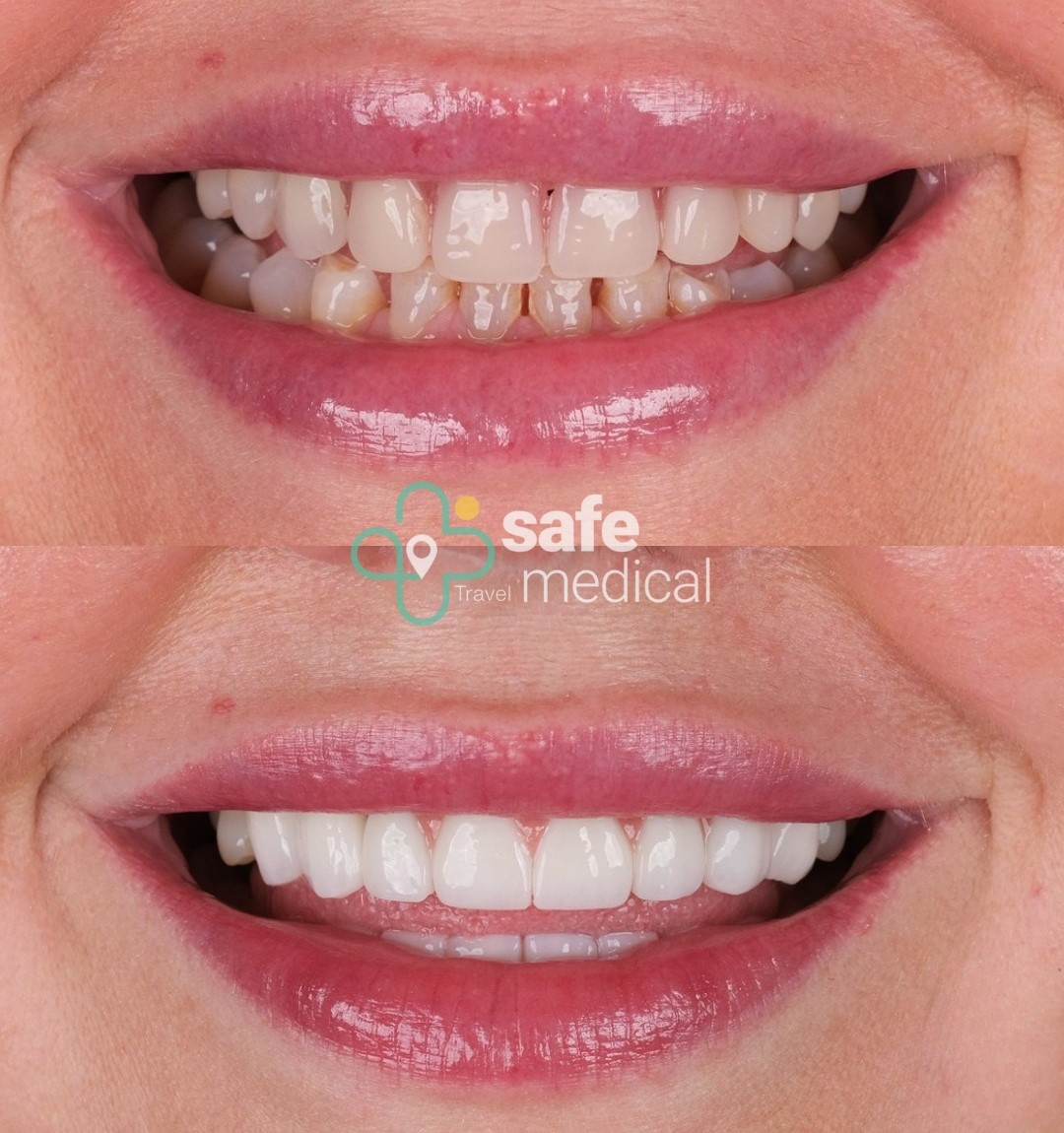
Resin crowns:
These are more affordable but less durable materials, generally used for temporary restorations.
What are the types of dental veneers?
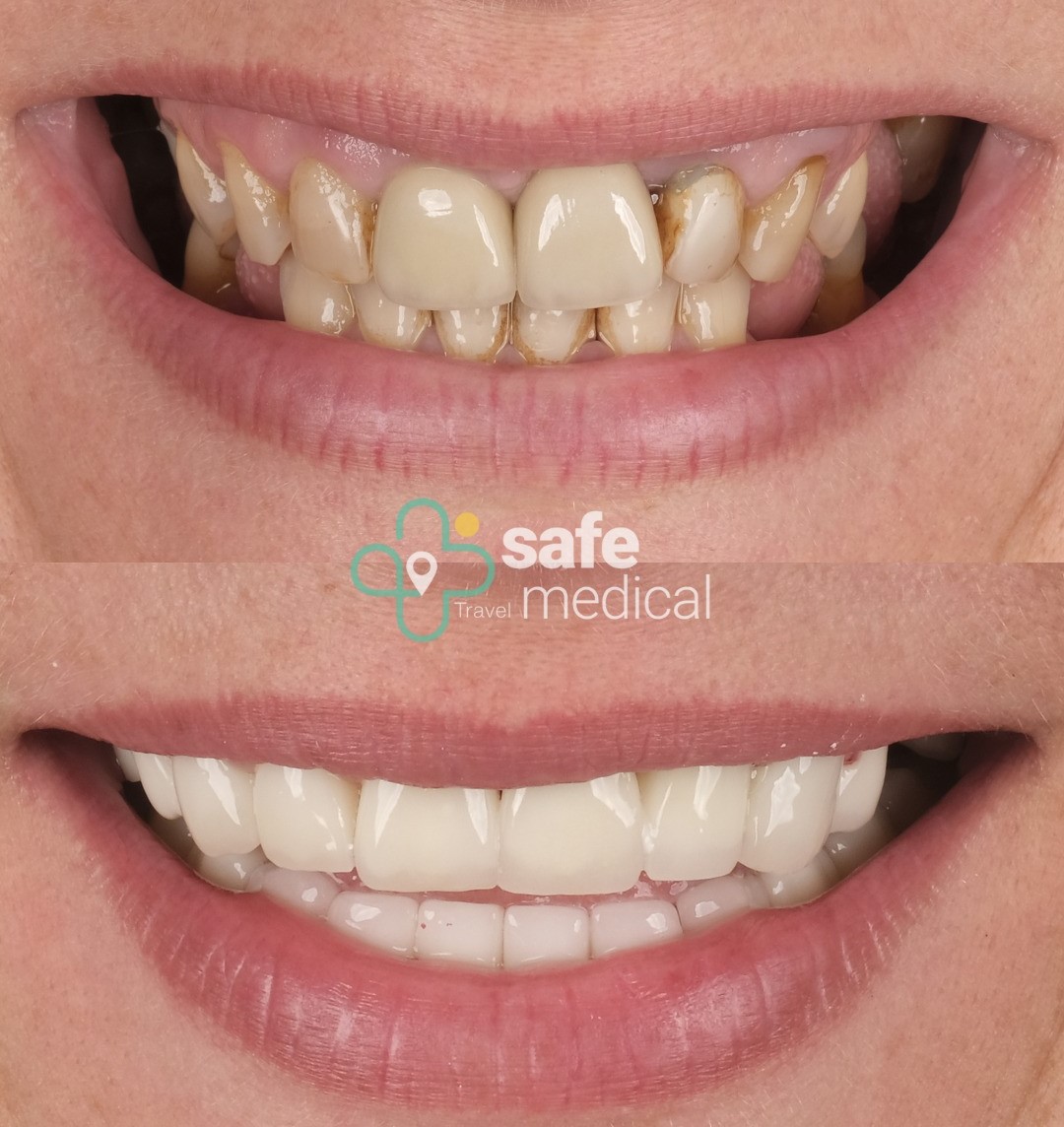
Dental veneers (dental laminate applications) are categorised according to both the material used and the extent to which they cover the tooth (coverage area).
Veneers according to the material used
Veneers are generally produced from the following materials, which provide durable and aesthetic results:
Porcelain veneers:
These are specially made thin ceramic shells that fit onto the front surface of the tooth like false nails.
Composite veneers:
These are applications made using composite resin layers instead of porcelain.
Special ceramic systems:
In modern dentistry, advanced porcelain types such as E-max (lithium disilicate) or IPS-Empress are preferred for their high durability and aesthetics.
Veneers according to coverage area
- Veneers for front teeth
- Veneers for back teeth
Pros and cons of Veneers
Pros of veneers
- Protects tooth structure: Veneers are a much more conservative (protective) procedure compared to full crowns (caps). Only minimal abrasion of 0.3 to 0.5 mm is required from the front surface of the tooth.
- Excellent aesthetic results: It provides a natural-looking smile by improving the shape, size, colour, and even slight misalignment of the teeth.
- Conceals imperfections: It is ideal for covering stains that cannot be removed by teeth whitening, cracks, chips, and gaps between teeth (diastema).
- Long-lasting: Porcelain veneers are durable and, with proper care, maintain their aesthetic appearance for many years (generally 5-10 years or more).
- Gum compatibility: As they can remain above the gum line (supragingival) during preparation, the risk of gum irritation is lower.
Cons of veneers:
- It is a permanent procedure: As part of the enamel is permanently removed during application, the tooth can never be restored to its original condition.
- Limited protection: Veneers only cover the front surface of the tooth; they do not provide any protection or support to the back (tongue side) surface of the tooth.
- Limited use: If the tooth is severely decayed, excessively worn, or has large fillings, a crown (cap) that provides complete protection is more appropriate than a veneer.
- Colour change problem: If you later whiten your natural teeth, your porcelain veneers will not change colour, so your artificial teeth may look mismatched with your other teeth.
- Sensitivity and treatment risk: As with any intervention on tooth tissue, sensitivity may rarely occur after the procedure, or there may be a risk that the tooth will require root canal treatment.
Pros and cons Crowns
Pros of crowns:
- Strengthening and protection: It protects against fractures by completely covering teeth that have been weakened due to breakage, excessive wear, or large fillings.
- Functional support: It provides protection against chewing forces, especially in the back teeth, and acts as a ‘brace’ to preserve the structural integrity of the tooth.
- Protection after root canal treatment: As teeth that have undergone root canal treatment often become more fragile, crowns are critical in protecting the health of these teeth.
- Smile design and restoration: Improves the appearance of teeth that are misshapen or discoloured. It is also used to hold dental bridges or cover dental implants.
- Partial crown option: ‘Partial crowns’ (P.V.C.), which cover only part of the tooth rather than the entire tooth, allow for the preservation of more natural tooth structure.
Cons of crowns:
- Tooth structure loss: In order for the crown to fit the tooth perfectly, the dentist must grind (cut) away some of the natural tooth enamel and structure.
- Not permanent for life: Crowns do not last a lifetime; their average lifespan is between 5 and 10 years, but with good care they can last 20–30 years.
- Risk of root canal treatment: A small percentage of teeth that have been crowned may require root canal treatment after the procedure or years later.
- Aesthetic issues and gum recession: Over time, if the gums recede, a dark line may be visible at the gum line, especially with metal-supported porcelain crowns.
- Sensitivity and breakage: Tooth sensitivity and gum irritation may occur during the use of temporary crowns or after the placement of permanent crowns. There is also a risk of cracking or breaking on porcelain surfaces over time.
- Incompatibility with whitening: If you whiten your natural teeth, the crowns will not change colour, which may result in a colour mismatch with your other teeth.
Tooth Crown vs Veneer Price
Factors influencing the cost of dental crowns and veneers are as follows:
Materials and technology used
The price of treatment varies depending on the type of material selected and the production technology. For example, the use of special ceramics such as E-MAX, which offer high aesthetics and durability, is a factor affecting cost.
Additional procedures and expenses
Depending on the condition of the tooth, crown treatment may require more additional procedures and therefore incur additional costs compared to veneer application:
- Build-up and foundation: Procedures involving the use of resin material to support the tooth structure may incur an additional fee.
- Gum procedures: Gingivectomy (trimming of gum tissue) may be required to determine the margin where the restoration will be placed, and this procedure incurs an additional cost.
- Root canal treatment: Root canal treatment that may be required during or after crown or veneer preparation is a factor that increases the total cost.
Type of service (public vs. private)
Dentists will indicate which options are available under the NHS (National Health Service) and which are offered as private options, depending on the patient's circumstances. Private options are generally more expensive.
Long-term cost (need for replacement)
In cases such as gum recession, porcelain breakage, or secondary decay, the restoration will need to be replaced, which means further expenditure in the long term.
Which are best for front teeth?
The ‘best’ option for front teeth depends on the current health of your teeth and your aesthetic goals. Dentists typically choose between porcelain veneers (laminate) and full crowns.
Details on which option is more suitable for your situation:
When should veneers (laminate) be chosen?
If your teeth are generally healthy but you are unhappy with their appearance, veneers are usually the best option.
- Conservative approach: Veneers are much more conservative than crowns because they require very little grinding of the tooth enamel, only between 0.3 mm and 0.5 mm.
- Areas of use: They are ideal for closing gaps between teeth (diastema), correcting minor misalignments, hiding cracks, or masking stains that cannot be removed by whitening.
- Aesthetics: They provide a natural and long-lasting aesthetic result by covering only the front (visible) surface of the tooth.
When should a crown be chosen?
If your tooth is structurally weakened, a crown is a more sensible and safer choice.
- Structural support: If your tooth has extensive decay, excessive wear, large old fillings, or root canal treatment, a crown encases the entire tooth, creating a ‘bracing’ effect and preventing fractures.
- Comprehensive restoration: It protects both the front and back (tongue side) surfaces of the tooth, providing resistance to chewing forces.
Best material options for front teeth
For the aesthetics of front teeth, ceramic (porcelain) materials with high light transmission are preferred:
- E-MAX (Lithium disilicate): Due to its transparency, which is very close to natural tooth enamel, its high durability, and its aesthetic success, it is a particularly recommended option for front teeth.
- Porcelain-fused-to-zirconia (PFZ): If there is a metal post or a very dark tooth structure underneath the tooth, zirconia-supported porcelains may be preferred to mask this darkness; this material is both durable and opaque.
- Procera AllCeram / IPS-Empress: These types of all-ceramic systems offer perfect colour matching and a ‘natural’ appearance for front teeth.
Summary decision guide
- If there is minor damage or discolouration: Veneer (Laminate).
- If there are large fractures, extensive decay, or root canal treatment: Full Crown (Capping).
Have you had any major fillings or root canal treatment done on your teeth before? This may cause your dentist to recommend a crown instead of a veneer.
Frequently Asked Questions
Is it better to get crowns or veneers?
Which procedure is better for you depends entirely on the current health of your tooth, the amount of damage, and your aesthetic goals. As a general rule, if your tooth is generally sound but you want to improve its appearance, a veneer is the better choice; if your tooth is weakened or severely damaged, a crown is the more appropriate option.
The detailed comparison below will help you determine the most suitable option for your situation:
|
Feature |
Dental Veneer |
Dental Crown |
|
Area of Coverage |
Covers only the visible front surface of the tooth. |
Covers the entire tooth, including all chewing surfaces and sides. |
|
Tooth Preparation |
Much more conservative; requires minimal reduction of 0.3–0.5 mm of enamel. |
Requires significant reduction; all sides of the tooth must be trimmed to fit the restoration. |
|
Main Purpose |
To improve esthetics by correcting color, shape, alignment, and masking stains. |
To strengthen, protect, and restore function to damaged, broken, or weakened teeth. |
|
Durability & Support |
Focuses on cosmetics; consists of thin porcelain or composite shells. |
Highly resistant to bite forces; provides structural "bracing" to maintain tooth integrity |
What lasts longer, veneers or crowns?
The average lifespan for both crowns and veneers is between 5 and 10 years; however, with excellent care, both restorations can last up to 20 or 30 years. No restoration is permanent for life, and a person may need to have them replaced several times during their lifetime.
The key differences and factors that determine how long these restorations will last are as follows:
The most durable materials
- Gold crowns: Generally considered the most durable option among all materials.
- Modern porcelains: Full ceramic crowns (such as Procera AllCeram) are particularly durable; in 5-year clinical studies, no fractures were observed in these crowns placed on front teeth.
- Porcelain vs. Composite: Porcelain veneers and crowns are much stronger, more durable, and provide longer-term protection than composite fillings.
What is the lifespan of veneers vs crowns?
Although dental crowns and veneers are permanent solutions, they do not last a lifetime and may need to be replaced several times during a person's lifetime. Their average lifespan generally ranges from 5 to 10 years, but with good care, they can last for 20 or 30 years.